
General
This is the main section of Master Wrapper that defines what application the wrapper is built for. Simply load or drag and drop MSI to fill out the form, or do it manually. Fill out the description for it to be automatically filled out when uploading the package to Intune if using Master Packager Toolbox. Master Wrapper also automatically sets a registry key that will be used for detection in Intune.
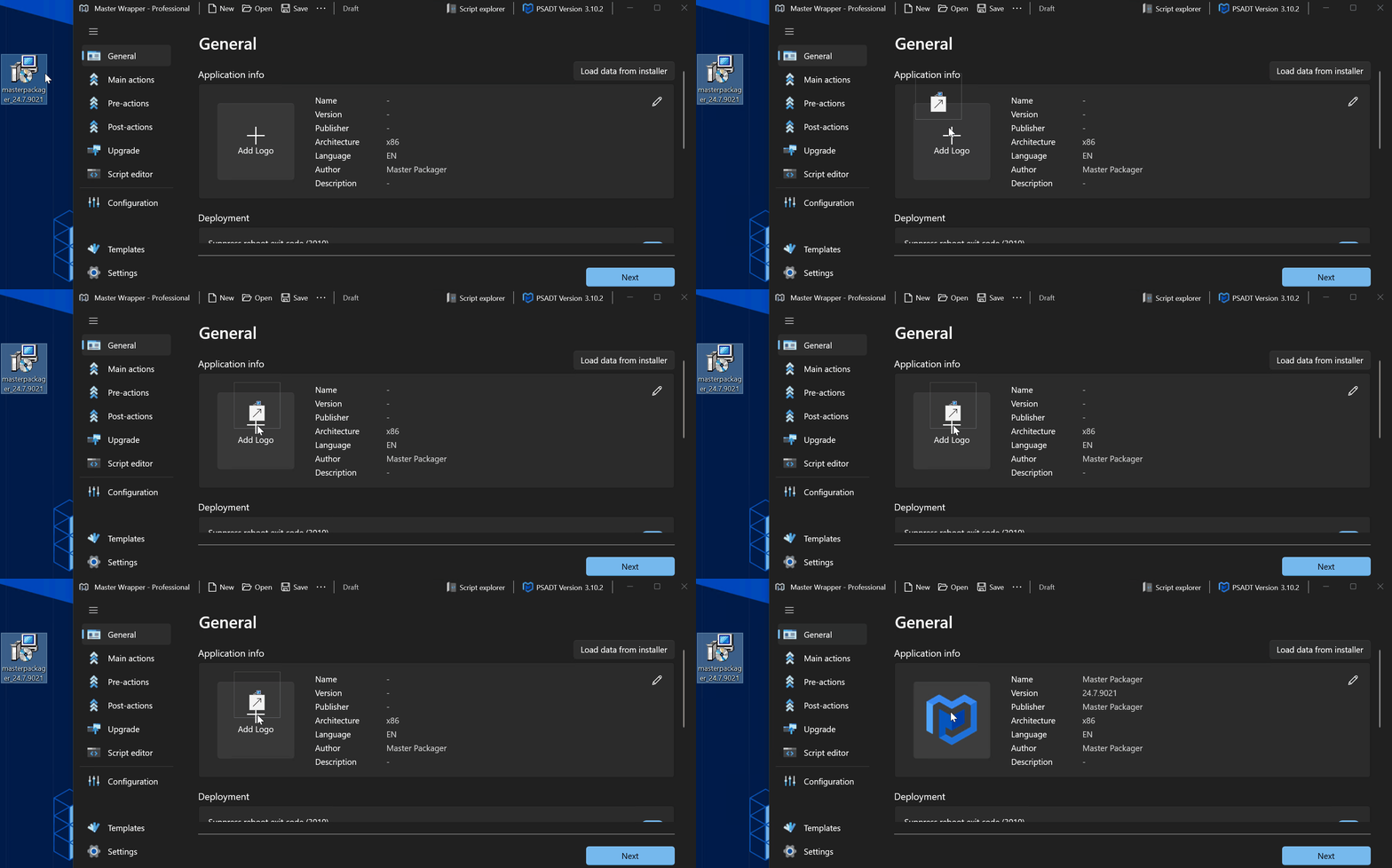
Application Info
This area contains metadata about the application being wrapped. It defines how the package is identified and displayed in management systems or logs:
- Name – The name of the application.
- Version – The version number of the wrapped application.
- Publisher – The software publisher’s name.
- Architecture – Target platform - x86, x64 or arm64.
- Language – The language used in the application.
- Author – Name of the person/organization creating the package.
- Description – Optional information describing the package.
You can automatically fill these fields using the Load data from installer button, which retrieves details from the original MSI or EXE installer or by drag and drop.
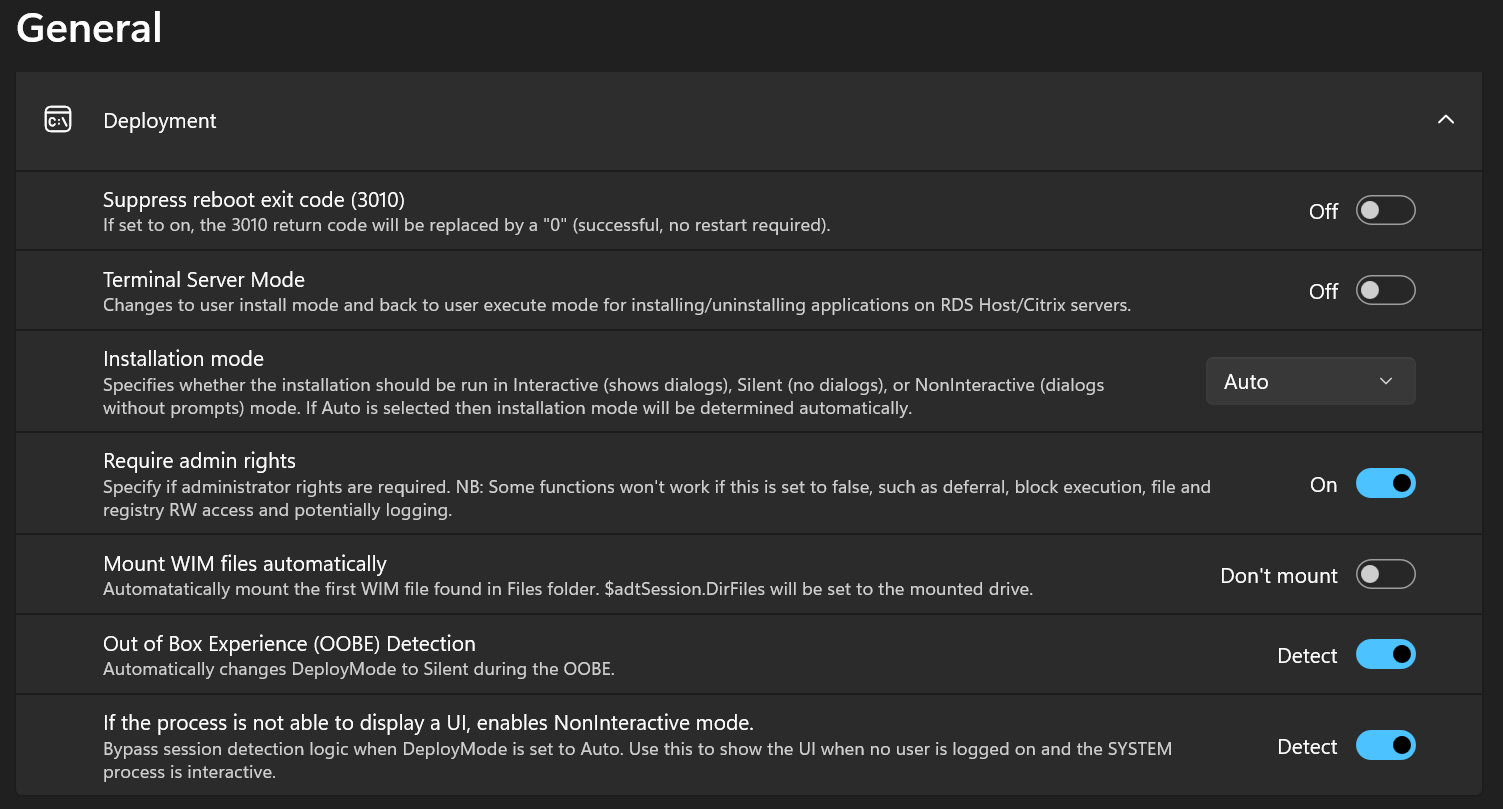
Deployment
This section controls installation behavior, permissions, and UX:
- Suppress reboot exit code (3010) – If set to on, the 3010 return code will be replaced by a “0” (successful, no restart required).
- Terminal Server Mode – Changes to user install mode and back to user execute mode for installing/uninstalling applications on RDS Host/Citrix servers.
- Installation mode – Specifies whether the installation should be run in
- Interactive mode (shows dialogs)
- Silent mode (no dialogs)
- NonInteractive mode (dialogs without prompts)
- Auto (if selected then installation mode will be determined automatically)
- Require admin rights – Specify if administrator rights are required. NB: Some functions won’t work if this is set to false, such as deferral, block execution, file and registry RW access and potentially logging.
- Mount WIM files automatically – Automatically mount the first WIM file found in Files folder. $adtSession.DirFiles will be set to the mounted drive.
- Out of Box Experience (OOBE) Detection – Automatically changes DeployMode to Silent during the OOBE.
- If the process is not able to display a UI, enables NonInteractive mode – Bypass session detection logic when DeployMode is set to Auto. Use this to show the UI when no user is logged on and the SYSTEM process is interactive.
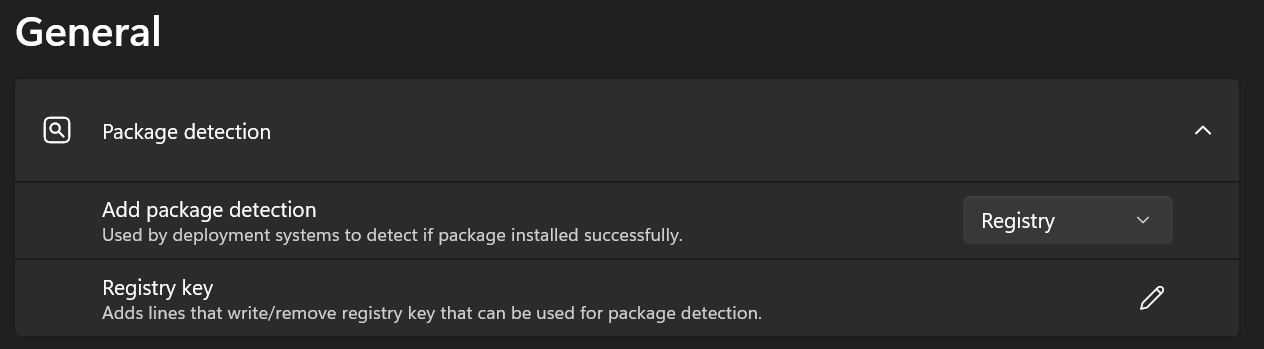
Package Detection
Package detection defines how the system determines whether an application is installed.
You can add rules by selecting Add rule and choosing one of the available methods:
- MSI
- Registry
- Predefined registry
- File
- Script
Each rule checks a specific condition on the system. If the conditions are met, the application is reported as installed.
MSI Product Code detection
This method verifies installation using the MSI Product Code.
You can also enable version checking to detect if a newer version is installed.
When version checking is enabled, you can select one of these rules:
- Equals
- Not equal to
- Greater than
- Greater than or equal to
- Less than
- Less than or equal
If version checking is disabled, only the Product Code is checked.
Registry detection
Registry detection checks whether a specific registry key or value exists.
There are two types of registry detections:
- Predefined registry detection, which is generated automatically based on application data in Master Wrapper
- Custom registry detection
Custom registry detection
In custom registry detection, the key and value are defined manually. You can also enable option to Search 32-bit registry on 64-bit clients.
Available registry detection methods:
- Key exists
- Key does not exist
- String comparison
- Equals
- Not equal to
- Version comparison:
- Equals
- Not equal to
- Greater than
- Greater than or equal to
- Less than
- Less than or equal to
- Integer comparison
- Equals
- Not equal to
- Greater than
- Greater than or equal to
- Less than
- Less than or equal to
File detection
File detection verifies the installation status based on a file or folder path.
You can also enable option to Search 32-bit path on 64-bit clients.
Available file detection methods are:
- File or folder exists
- Date modified
- Equals
- Not equal to
- Greater than
- Greater than or equal to
- Less than
- Less than or equal to
- Date created
- Equals
- Not equal to
- Greater than
- Greater than or equal to
- Less than
- Less than or equal to
- Version comparison
- Equals
- Not equal to
- Greater than
- Greater than or equal to
- Less than
- Less than or equal to
- Size in MB
- Equals
- Not equal to
- Greater than
- Greater than or equal to
- Less than
- Less than or equal to
Script detection
Script detection uses a PowerShell script.
The script must use Write-Output to report successful installation.
If the exit code is zero and output is returned, the application detection status is installed. Any other exit code reports failure.
You can:
- Enforce script signature check and run it silently
- Run script as 32-bit process on 64-bit clients
- Script content or external PS1 file
Note that only one script detection rule can be added to the package, and no other detection rule can be applied.
Additional Information
Provides extra information about the application for deployment and documentation.
- Information URL – Link to a website or documentation that has more information about the app. The URL will be visible to users in Company Portal.
- Intune Categories – Specifies Intune categories that are automatically prefilled when uploading package using Master Packager Toolbox. Available categories include:
- Books & Reference
- Business
- Collaboration & Social
- Computer Management
- Data Management
- Development & Design
- Other Apps
- Photos & Media
- Productivity
- Notes – Add app dependency names, specific install instructions, ticket ID, etc. Text will be added to Notes section when uploading to Intune via Master Packager Toolbox.